Your AI Is Making You More Competent and More Replaceable
Blog

It's 11:40 p.m., and the deck is due at 8 a.m. Your client's leadership team is split: automate the customer service function and cut headcount, or augment the team with AI and retrain people into higher-value work. There's no clean data pointing either way. Just a board that wants a confident recommendation by morning, and a consultant whose entire fee is justified by having one.
So, despite your years of experience, you open an AI chat window, describe the situation, and ask for a final recommendation. What comes back sounds sharp and specific, tailored to your client's exact requirements. It sounds confident. But at nearly midnight, you don't have time to figure out whether that confidence is accurate, or just sounds like it.
The Flattening Is Already Here
When a critical mass of knowledge work runs through the same handful of foundation models, individual output improves, but output across different people converges toward the same structure, tone, and ideas. The floor rises, and the ceiling gets crowded. Everyone reaches competent. Fewer break past it. We call this “flattening.”
Researchers from Harvard Business School, MIT Sloan, Wharton, and the University of Warwick ran the most rigorous test of this effect to date, a preregistered experiment with 758 professional consultants. The productivity gains were real. But the technology's relatively uniform output reduced the group's diversity of thought by 41%, and that loss held even after participants edited the AI's work. Editing did not restore the range. The convergence was baked in upstream, at the model level, before anyone touched the output.
Gen-AI use has reached 79% of organizations in 2025, up from 33% in 2023. The tool is nearly everywhere. Peer-reviewed research in Science Advances confirms the same pattern at the individual level: AI-assisted work is more creative on average, but more similar across people.
Foundation models are all trained on similar data, all predicting the same most-likely next word. Similar inputs, similar outputs. Researchers call it algorithmic monoculture. And at the scale we're seeing today, it's not a personal habit you can prompt-engineer your way out of. It's a market-level force.
A March 2026 Harvard Business Review study tested six leading AI models, including GPT-5, Claude, Gemini, Grok, DeepSeek, and Mistral, across seven core strategic tensions in more than 15,000 simulations: tradeoffs like whether to prioritize long-term or short-term growth, or automate or augment a team. If the models were reasoning from the specifics of each scenario, their answers should have varied. Instead, they converged, clustering around the same fashionable managerial framing regardless of the situation. Researchers call the pattern trendslop, and their warning cuts to the center of this: an AI can sound tailored to your exact situation while quietly steering you toward the same narrow set of trends as everyone else who asked. Automate or augment a team, for instance, the same split your client's board is deadlocked on right now. The model's answer isn't shaped by your client's numbers. It's shaped by what sounds most defensible on a slide deck.
The Asset Being Quietly Sunsetted
Two-thirds of organizations are currently using AI to optimize what’s already there rather than to reimagine what is possible. That is Deloitte's read from a 2026 survey of 3,235 enterprise leaders across 24 countries.
For a senior independent expert, that context matters because your market value has always rested on two things: the quality of your judgment and the distinctiveness of how you frame problems. The Flattening does not attack your judgment directly. It attacks the signal-to-noise ratio around it. When your output and your competitor's output are both competent, and both are AI-assisted, the reader cannot tell the difference. The infrastructure you and your competitor share is quietly erasing the distinctiveness of your judgment.
The Fix Is Not More Memory
The industry response to this problem is personalization through memory: tools that recall your past conversations, learn your preferences, and deliver responses that feel more tailored over time. The value story is recall. The promise is that the tool will know you better.
But memory only stores the past. The reasoning underneath stays the same.
When millions of memory-personalized users pull from the same foundation models, that convergence holds. Personalization makes the tool more convenient. It does not make your output diverge from everyone else's, because the reasoning engine underneath is identical for all of them.
How you reason is what keeps your work yours. That's the variable digitized memory can't replace.
Judgment That Isn't Used Erodes
Your judgment isn't just an abstract idea. Cognitive psychologists have spent decades studying exactly this asset, and the research explains both why it holds up and why it doesn't survive being outsourced.
Gary Klein's Recognition-Primed Decision model found that skilled professionals under pressure don't weigh a list of options. They recognize a situation as matching a pattern built from years of prior cases, then briefly simulate the response before acting. Expert intuition is analysis, compiled through repetition into instant recognition.
That compiled asset only holds up under specific conditions. In a paper that resolved decades of disagreement in psychology, Daniel Kahneman and Gary Klein concluded that expert intuition is reliable when the environment is regular enough to learn from and the expert has had extended exposure to fast, clear feedback on being right or wrong. Those are the exact conditions a senior consultant accumulates over a career: years of observations, years of making calls, and years of watching how those calls turned out.
The harder finding is what happens once that judgment stops being used. A 2025 study in The Lancet Gastroenterology & Hepatology tracked experienced endoscopists, each with more than 2,000 prior procedures, before and after they began using AI-assisted polyp detection.
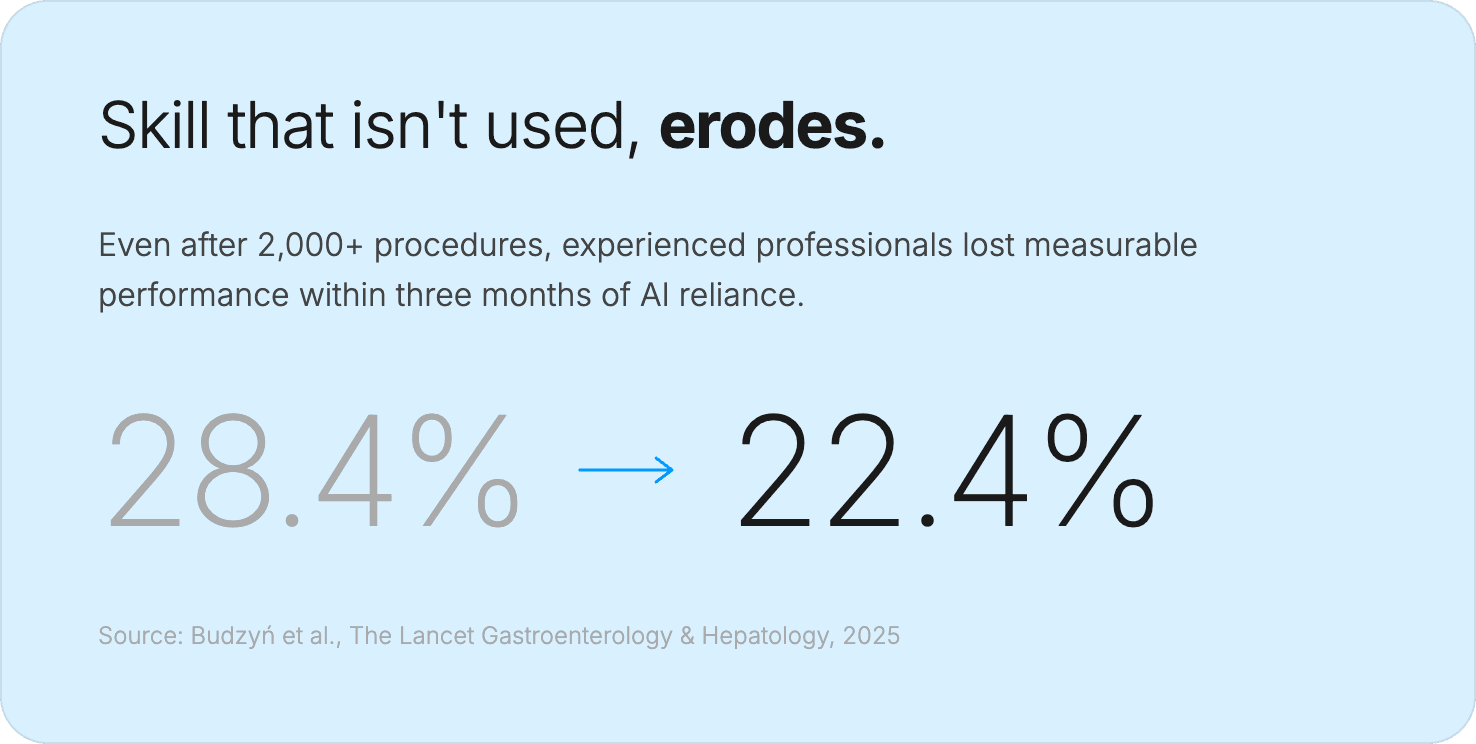
When the AI was switched off, their unassisted detection rate had declined from 28.4% to 22.4% within three months, a 6.0 percentage point absolute drop. The skill did not stay dormant while the AI carried it. It measurably eroded.
That is the deeper stake here: reasoning is a skill your career built through practice, and practice is exactly what gets skipped when a generic tool starts making the calls for you.
What Stays Yours
The floor has risen. Median consultants, strategists, and content writers are producing better work than they were three years ago. That is genuinely valuable and worth saying plainly.
But in a market where the floor has risen for everyone, breaking above that crowded ceiling is what matters. What gets you there is something memory cannot replicate: the specific way you connect ideas and arrive at conclusions that are distinctively yours. That is the reasoning layer that no chat history can hold, and no preference profile can capture.
Generic AI makes everyone more capable. TwinWise makes your output irreplaceable.
—
Frequently Asked Questions
What is "the Flattening" in AI-assisted work?
The Flattening is what happens when a critical mass of knowledge work runs through the same handful of foundation models: individual output gets better, but output across different people converges toward the same structure, tone, and ideas. The median rises while the range of distinct work shrinks.
Why does AI-generated writing from different people sound similar?
Models trained on similar large-scale corpora, predicting the most likely next token, tend to produce similar outputs for different people with comparable inputs. Researchers call this algorithmic monoculture. A 2023 study by Harvard Business School, MIT Sloan, Wharton, and the University of Warwick measured a 41% reduction in idea diversity among professionals using GPT-4 for the same task, and the effect held even after participants edited the AI's output.
Does AI memory or personalization prevent AI outputs from converging across different users?
No. Memory features that recall past conversations and preferences make a tool more convenient, but they don't change how the underlying model reasons. When many personalized users draw from the same foundation model, their outputs still converge, because personalization changes what the tool remembers, not how it thinks.
What is a Cognitive Twin Platform?
A Cognitive Twin Platform is a system built to model how a specific person reasons, rather than simply storing what they've said or what they prefer. TwinWise is built on this model, designed to protect and extend the reasoning that makes an expert's output distinctively theirs.
Tristian Lacroix, Head of Marketing, TwinWise AI