Memory Is Not Understanding: Why an AI That Remembers You Still Doesn't Know You
Blog

TL;DR: AI memory and AI understanding are not the same thing. Memory stores what you said. Understanding infers how you think. Today's leading platforms retain facts and preferences well, but they optimize for retrieval rather than inference, so their output stays generic even as the data piles up. The gap is architectural, not a feature the next release closes. It already shows up in enterprise ROI, and in falling user trust.
Feed a leading AI assistant a year of your work, and it will recall almost all of it. The names, the preferences, the projects, the way you like your emails to end. Then ask it to make the decision you would make, and it hands you the call anyone would make. It has a year of your history and none of your judgment.
A strategy lead gets a forty-page diligence report late on a Tuesday afternoon. Nothing is on fire. She has read hundreds of these, and what makes her good at it is knowing which paragraph is load-bearing and which is filler.
She asks her AI to summarize it, and it does, accurately. Eight bullets. The executive summary compressed, the financials pulled forward, the risks listed at the end in the order the report listed them.
It is a good summary. It is the summary anyone would get.
What it misses is what she would have caught. That the customer-concentration figure sits in an appendix, and that the placement is itself the signal. That the management tenure numbers don't support the growth story three pages earlier. That the risk she would have put first is the one the report put fourth.
Her AI has a year of her work. It knows she wants summaries short and reads risk sections first. It has read the report. What it cannot do is read the report as her.
That gap isn't a feature the next release adds. It's built into how these tools work, and it's already costing experts and companies where they can least afford it.
What the industry actually built
First, let's acknowledge that the leading platforms are producing great solutions. Persistent memory, preference retention, and cross-ecosystem integration are genuine engineering achievements, and the teams behind them are solving hard problems well. It's also worth looking at how those approaches work, because the pattern that connects them is the whole story.
One approach saves what you tell it to save. You give that system an explicit instruction to remember something, and it holds onto it. Tell it you prefer to open a client conversation with the risk case rather than the opportunity case, and that preference persists. It's a clean, predictable design: the user decides what matters, and the system honors it. What it captures is declared preference. What it doesn't capture is the reasoning you never stopped to declare, because you were busy doing the work.
Another approach builds memory from ecosystem breadth. It connects across mail, photos, search, and more, assembling a wide picture of the person from the surface area of their digital life. The logic is sound: more signals, more context. In practice, that context often lives in separate places and doesn't move freely between a consumer surface and an enterprise one. The picture is wide, and it is also partitioned.
A third approach treats memory as retrieval. That model extracts facts from your conversations, stores them as entries, and pulls the relevant ones back when they seem useful. It's a powerful, well-understood pattern, essentially a very sophisticated notebook. It records what was said. Reconciling a thing you said once in passing against a thing you believe deeply, or noticing when a view you held has since changed, sits outside what a record is built to do.
None of these is a flaw. Each solves the problem it set out to solve. But notice what they have in common: all three optimize for retrieval. They are built to store information reliably and return it accurately. That is a genuine capability, and it is a different capability from inference, which is the ability to read how a person reasons and apply it to a situation the system has never seen.
Retrieval answers "what did this person say?" Inference answers "how does this person think?" The industry has gotten very good at the first question. The second is still open ground.
That distinction isn't academic, and the cost of missing it is starting to appear in the numbers. Only 39% of organizations report any EBIT impact from AI, and among those, most put that impact below 5% of EBIT (McKinsey, "The State of AI in 2025," November 5, 2025). Separately, fewer than one-third of decision-makers can tie the value of AI to their organization's financial growth at all (Forrester, "2026 Technology & Security Predictions," October 28, 2025). Adoption is nearly universal. Attributable value is not. There are many reasons for that gap, but one is that a tool that retrieves without inferring produces output that is technically responsive and rarely yours.
Why retrieval and inference are different problems
Human memory doesn't work like a store of records, and the difference is instructive.
When you remember something, you don't open a file. You reconstruct it. Recalling a hard conversation brings back the room, the relationship, the stakes you felt, and the decision you reached afterward, all at once and all bound together. That binding is what turns a recollection into understanding. It's why you can take a lesson from one situation and apply it to a completely different one.
A retrieval system works the other way around. It relies on fixed methods and stored parameters. It can reproduce language and tone with real precision, and its working memory is vast. What it doesn't do is carry the intent and context that lets a person move an insight from where it was learned to where it's needed.
This is why more data doesn't close the gap. Feeding a retrieval system more facts gives you a longer record, not a deeper model of the person. The move from recall to comprehension isn't a volume problem. It's a design decision, made at the foundation or not made at all.
What "retrieval without understanding" costs
The consequences aren't philosophical. They show up on both sides of the transaction.
Inside the enterprise, the pattern is familiar. Pilots show early promise, then stall at scale. Vendors answered the stall by shipping more memory: longer context windows, persistent threads, knowledge-base integrations. Those features capture more. Capturing more is not the same as understanding more, which is why the EBIT numbers above have barely moved.
On the user side, trust is heading the wrong way.
52% of consumers now trust AI less than humans with their personal data, up from 48% a year earlier (Usercentrics, State of Digital Trust 2026, conducted by Sapio Research, fieldwork March 2026).
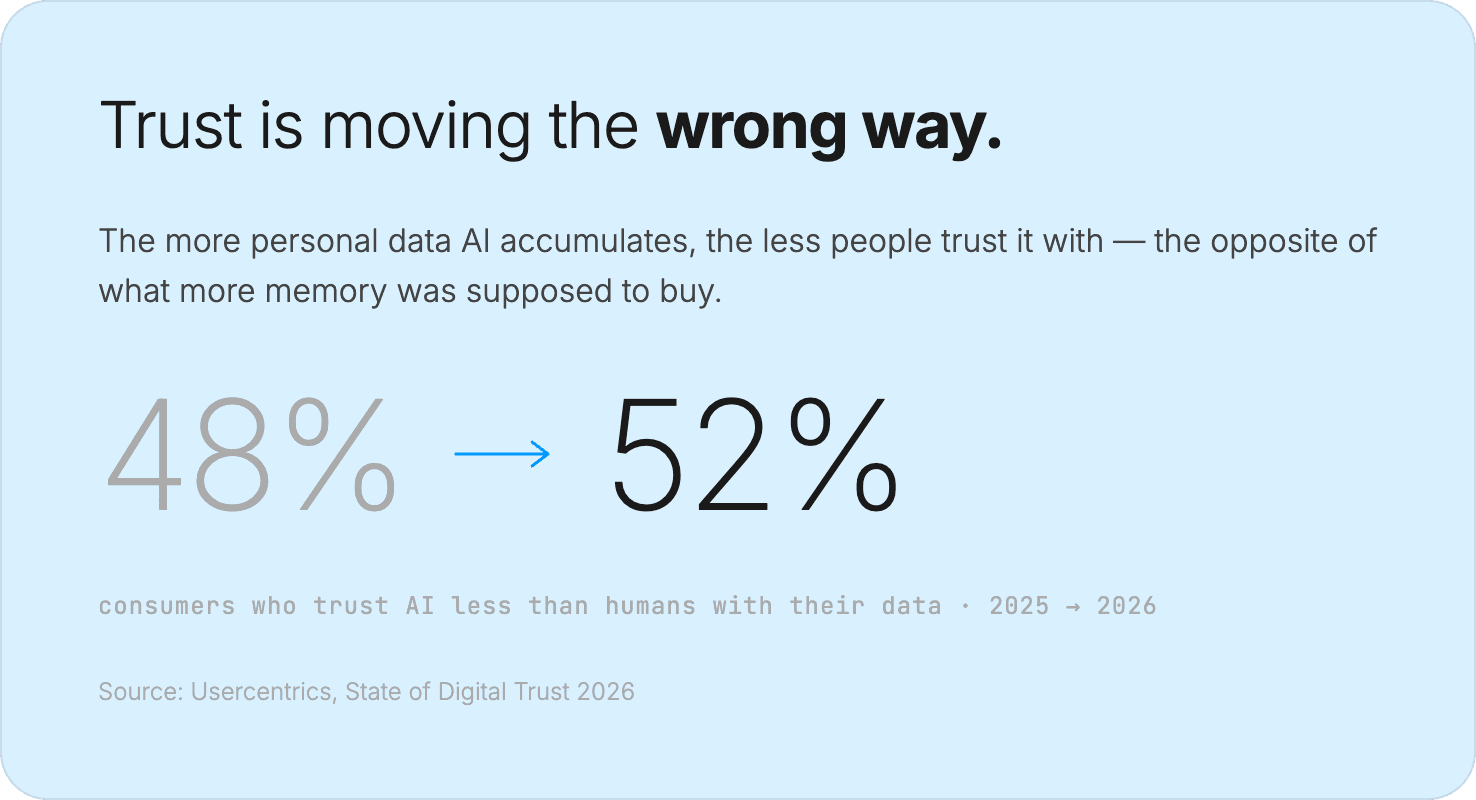
That erosion has a revenue signature: in the same study, 47% of consumers took at least one action with a direct financial consequence, such as canceling a subscription, switching to a competitor, or cutting their spending.
The tools that were supposed to drive productivity can quietly drive churn instead. The tools aren't broken. They misread the people using them.
What understanding actually requires
Inference is not a better-stocked record. A system can hold every document you have ever given it and still miss the thing that matters most: the reasoning you never wrote down.
That is the part retrieval structurally cannot reach. When you make a hard call, most of the work happens before a single word is typed. You weigh what the situation is actually asking and settle on a framing before you commit to it. By the time anything reaches the page, the judgment is already made, and the reasoning behind it has evaporated. A tool built to store what was said starts a step too late.
Inference is the attempt to model that earlier step: how you decide, rather than what you prefer. It looks for where your thinking tends to stall, and what kind of framing moves you from analysis to a decision. A preference is a fact about you. That pattern is a model of you.
And it has to stay current. People change their minds, and a view you held strongly two years ago may be one you have since abandoned. Understanding means a model that updates as you do, not a snapshot frozen the last time you touched your settings.
That is a different design philosophy, and it needs a different starting point.
The open ground: from retrieval to comprehension
The opening right now isn't a better memory store. Every major platform is racing toward the same retrieval ceiling, and they'll reach it at roughly the same time.
The opportunity is AI that moves from what you said to how you reason. From recall to comprehension.
TwinWise starts there. We capture how you reason directly from you, through a structured onboarding grounded in cognitive science, and build a living model of how you think that stays in sync as you change. Most AI is optimized for the tool. TwinWise is optimized for the human.
The distinction is the product. TwinWise builds your Cognitive Twin from how you actually think, reason, and decide, not from what you've uploaded or told it to remember. It isn't a chatbot and it isn't a preference engine. It doesn't need volumes of your documents. It partners with you to model how you reason. Your reasoning is the foundation it builds from, and your twin is designed to think with you, not for you.
The question worth asking your AI tool
Next time you're evaluating an AI platform, or reassessing the one you already run, change the question. Stop asking "Does this AI remember me?" and start asking "Does this AI understand me?"
They're not the same question, and the space between them is where most AI investment goes to waste.
We believe intelligence should be personal. TwinWise begins with the person.
Key takeaways
AI memory stores facts and stated preferences. AI understanding infers how a person reasons. They are different capabilities built on different architectures.
The leading approaches to AI memory all optimize for retrieval, storing and returning information reliably. Retrieval is a genuine achievement and a different problem from inference.
The gap is structural, not a coming update. More stored data produces a longer record, not a deeper model of the person.
The cost is measurable: only 39% of organizations tie any EBIT impact to AI (McKinsey, 2025), and consumer trust in AI with personal data is falling (Usercentrics, 2026).
To evaluate any AI tool, stop asking whether it remembers you and start asking whether it understands how you reason.
—
Frequently asked questions
Does my AI actually understand me?
Most current tools are built to retrieve rather than infer. They store what you tell them and return it accurately, but they generally don't reconcile conflicting statements, weigh a passing comment against a firm belief, or infer your reasoning from the pattern of how you work. They recall well. Comprehension is a separate capability.
Why does my AI forget how I think between sessions?
Most systems save declared information rather than inferred understanding. Unless you explicitly tell the system to keep something, the reasoning behind your requests usually isn't captured, and even saved facts go stale as you change. It feels like forgetting because the system never modeled how you reason in the first place.
Can adding more memory or data make AI understand me better?
No. The move from recall to comprehension is an architectural decision, not a volume problem. More stored facts give you a longer record, not a deeper model of the person. Understanding requires inference from how someone reasons, which a larger store doesn't provide by itself.
How can I tell if an AI tool understands me or just remembers me?
Ask three questions. First, how does it distinguish between what you said and what you meant? Second, how does its model of you update as you change? Third, what does it build from? If the answers point to saved instructions, manual settings, or stored documents, you're looking at a retrieval system, not an understanding one.
What is a Cognitive Twin?
A Cognitive Twin is an AI representation of how a specific person thinks, reasons, and decides, built to model their reasoning rather than store their data. TwinWise builds a Cognitive Twin through a structured onboarding grounded in cognitive science, and keeps it in sync as the person changes.
Tristian Lacroix, Head of Marketing, TwinWise AI